If a camera inspection shows your sewer line has collapsed sections, major offsets, or root intrusion that keeps coming back no matter how many times it's cut out, pipe bursting is usually the fix - not another round of cleaning. Pipe bursting only works when the old pipe can still act as a guide for the new one; if the line has already caved in flat or shifted out of alignment entirely, you're looking at open-trench replacement instead, which changes both the timeline and the disruption to your yard.
- Pipe bursting sewer replacement fits collapsed, offset, or repeatedly root-clogged lines that a camera can still trace end to end.
- Skip it if the pipe has fully caved in or shifted position - open trench becomes the only option.
- Cast iron lines from before the 1970s are the most common candidates in Middlesex, Monmouth, Ocean, and Union county homes.
- CIPP pipe lining is the cheaper trenchless alternative when the pipe still holds its shape.
Why this matters
Homeowners cut roots out of a sewer line two or three times in a year and assume the problem is solved each time. It isn't - recurring root intrusion at the same joint means the pipe itself is cracked or separated, and a video camera inspection is the only way to confirm it before you spend money guessing. Get it wrong and you either pay for a repair method that fails again in 2026, or you dig up a yard that didn't need full excavation.
A trenchless sewer repair for older homes with cast iron pipes approach exists specifically for this decision point - it's not a marketing term, it's a method that replaces a failed line without opening the whole run.
How do you know you need pipe bursting for sewer replacement?
The answer sits in three places: what the camera shows, how the pipe has behaved over time, and what material it's made from. Here's how pipe bursting stacks up against the two other common paths once a line has failed.
| Method | When it fits | When it doesn't |
|---|---|---|
| Pipe bursting | Pipe is cracked, offset, or undersized but traceable end to end | Pipe has fully collapsed or shifted out of its original path |
| CIPP pipe lining | Pipe still holds its round shape, minor cracks or root pinholes only | Pipe diameter needs to increase, or there are sharp offsets |
| Open trench | Multiple failure points, shallow depth, or utility conflicts | Yard has mature landscaping, driveway, or hardscape over the line |
If your camera inspection lands you in the middle row of that table, you likely need pipe bursting - not lining, not full excavation.
Recurring backups after cleaning signal structural failure
A line that backs up again within weeks of hydro jetting or cabling almost always has a structural problem, not just buildup. If the camera shows the pipe holding grease, paper, or sediment at the same spot every time, that's a sag or an offset joint catching debris - and cleaning it out again just buys a few more weeks.
Camera inspection showing a collapsed or bellied pipe
A "belly" is a low spot where the pipe has settled and water pools instead of draining. Video camera inspection is the only reliable way to see this, because a belly won't always cause a backup right away - it just collects solids until it does. Once a belly shows up on camera, pipe bursting resets the grade of the entire run.
Root intrusion that returns after cutting
Roots don't grow into a sound pipe. If roots keep coming back at the same joint after being cut, that joint is separated or cracked, and the roots will keep finding their way in until the section is replaced. A best trenchless repair method for tree root damage call usually comes down to how many joints are affected - one or two spots might take lining, a run riddled with root entry points needs bursting.
Cast iron pipe past its service life
Cast iron sewer lines installed before the 1970s commonly reach the end of their 50 to 75 year service life through corrosion from the inside out, not visible damage from outside. The pipe looks solid on the surface but flakes and narrows internally until flow slows to a trickle. Camera inspection catches this corrosion pattern well before a full collapse.
Undersized pipe for current fixture load
Homes with additions, finished basements, or extra bathrooms sometimes outgrew the original sewer line. Typical residential sewer lines run 4 to 6 inches in diameter, and if yours was sized for a smaller footprint decades ago, pipe bursting is one of the few methods that can pull a larger-diameter replacement pipe through the same path.
Why the need for pipe bursting varies
- Pipe material - clay and cast iron fail structurally; PVC rarely needs bursting unless it was damaged during installation
- Depth and access - pipe bursting needs two access pits, one at each end of the run, so depth affects excavation cost even in a "trenchless" job
- Number of failure points - one bad joint might take a spot repair; five or six spread across the run point toward full bursting
- Diameter change needed - if the line has to get bigger to handle current fixture load, lining won't do it but bursting can
- Landscaping and hardscape above the line - driveways, mature trees, and patios push homeowners toward trenchless methods even when the failure is severe
- Local soil conditions - shifting or heavy clay soils in parts of Monmouth and Ocean county accelerate offset joints in older pipe
“Pipe bursting works when the old pipe can still guide the new one through - once that path is gone, you're digging.”
Related questions
What's the difference between pipe bursting and CIPP pipe lining?
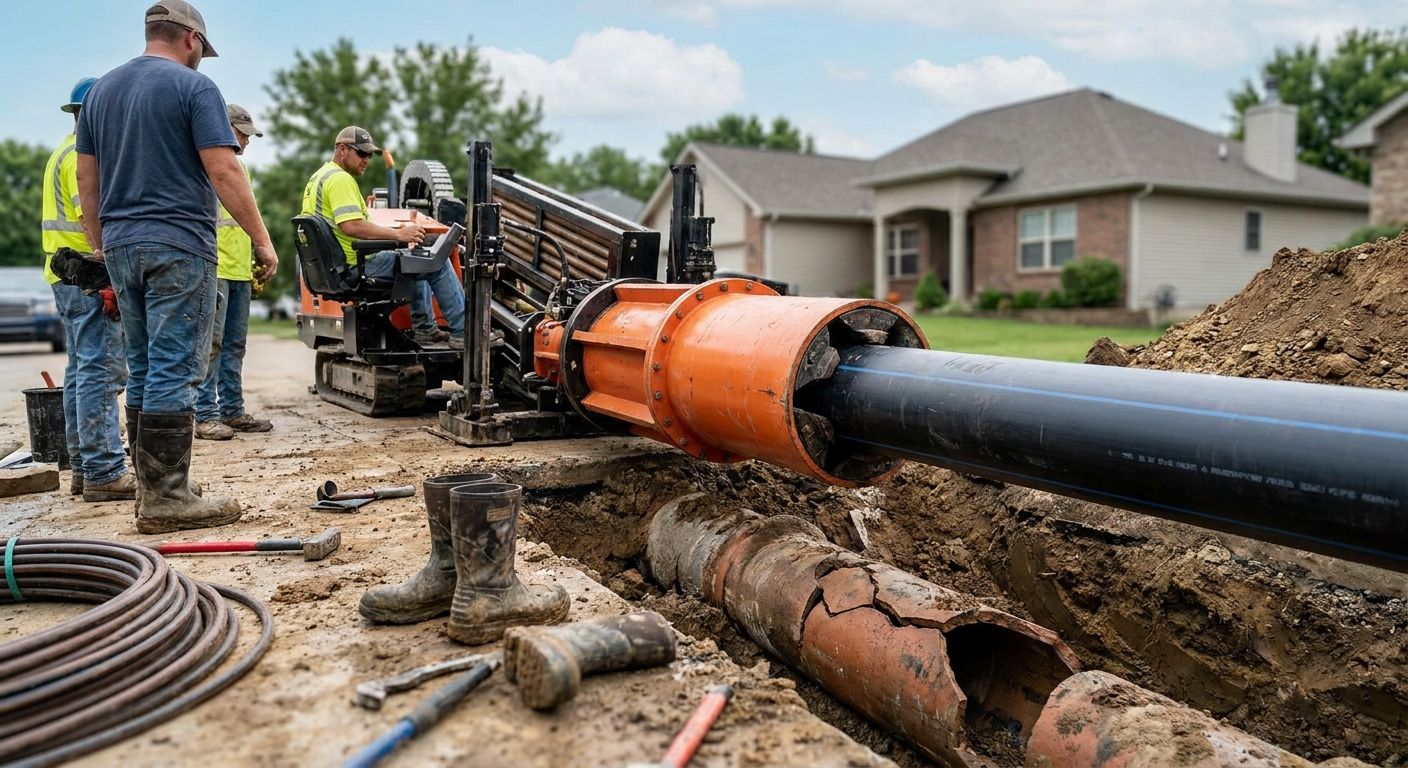
Pipe bursting fractures the old pipe outward and pulls a new pipe through the same path, while CIPP pipe lining inserts a resin-soaked liner inside the existing pipe without removing it. Bursting works on pipe that's cracked, offset, or undersized; lining only works if the pipe still holds its round shape.
Can pipe bursting fix root intrusion that keeps coming back?
Pipe bursting fixes recurring root intrusion by replacing the cracked or separated joints roots are entering through, rather than cutting the roots out again. Cutting alone is a temporary fix - the new pipe eliminates the entry points instead of just clearing what's already inside.
Does pipe bursting work on cast iron pipe?
Pipe bursting works well on cast iron pipe, and it's one of the more common methods used on the corroded cast iron lines found in homes built before the 1970s across Middlesex and Union county. The old cast iron is fractured in place and a new pipe is pulled through the same trench line.
If a camera inspection has already confirmed a collapsed section, an offset joint, or root intrusion that won't quit, get a second set of eyes on it before committing to a repair method. A sewer line repair for Ocean County homeowners evaluation walks through the camera footage with you and tells you straight whether bursting, lining, or a trench job is the right call - no upsell, just the read on the pipe.
Get your sewer line inspected
Camera inspection tells you if you need bursting, lining, or nothing at all.
FAQ
How long does pipe bursting take to complete?
Pipe bursting for a typical residential sewer line is usually a one-day job once access pits are dug, since the equipment pulls the new pipe through in a single continuous run. Longer runs or deep utility conflicts can push the job into a second day.
Is pipe bursting cheaper than digging up a sewer line?
Pipe bursting generally costs less than full open-trench excavation because it avoids tearing up the entire yard, driveway, or landscaping above the line. The exact savings depend on depth, length, and what's sitting on top of the pipe in 2026.
Can pipe bursting increase the size of my sewer line?
Pipe bursting can increase pipe diameter because the process fractures the old pipe outward to make room for a larger replacement. This makes it the right trenchless option for homes that added fixtures or square footage after the original line was installed.
Does pipe bursting work if my sewer line has already collapsed?
Pipe bursting does not work once a pipe has fully collapsed flat or shifted out of its original path, because the bursting head needs the old pipe to guide the new one through. A fully collapsed line usually means open-trench excavation instead.
How do I know if I need pipe bursting or CIPP lining?
You need pipe bursting instead of CIPP lining when the pipe is cracked, offset, or needs to get bigger, since lining only reinforces a pipe that still holds its round shape. A video camera inspection settles this before any repair method gets picked.
What causes a sewer line to need pipe bursting?
Cracked joints, root intrusion that returns after cutting, bellied or sagging sections, and corroded cast iron pipe past its 50 to 75 year service life are the most common causes. Camera inspection is what confirms which one is happening in your line.
Can pipe bursting be done in winter in New Jersey?
Pipe bursting can be done in winter as long as the ground isn't frozen solid at the depth of the access pits, which is typically a few feet down. Scheduling around a hard freeze is the main seasonal consideration in Middlesex, Monmouth, Ocean, and Union county.
One last thing
Most homeowners only find out they need pipe bursting after paying for cabling or jetting two or three times on the same line - the camera inspection that would have caught the structural problem costs less than one repeat cleaning visit. If a drain has backed up more than once at the same spot in 2026, ask for the camera footage before you approve another cleaning.