Property managers who own catch basin cleaning schedules need a fixed cadence, documented scopes, and proof of work that survives board reviews and municipal checks in 2026.
- Catch basin cleaning keeps stormwater inlets clear so parking lots drain and inspections pass.
- Property managers should set 1–2 cleanings per year and demand before/after photos plus waste tickets.
- Vacuum truck plus manual sump work is the baseline; hydro jetting handles hard-packed sediment.
- Statewide Sewer & Drain fits multi-site portfolios across Middlesex, Monmouth, Ocean, and Union counties.
Why catch basin cleaning matters for property managers
Property managers catch basin cleaning is the scheduled removal of sediment, leaves, trash, and oily residue from stormwater inlets with the aim of keeping lots drainable, tenants safe, and sites inspection-ready. Your job is different from a homeowner’s: you carry multiple sites, tenant complaints, insurance exposure, and municipal stormwater rules that treat neglected basins as your problem.
Standing water after a normal rain is not weather—it is a clogged sump. One blocked basin can flood a loading dock, cut off ADA paths, or push sheet flow into a storefront. In 2026, boards and asset managers expect a paper trail: service dates, debris volumes, and disposal tickets. Miss that trail and you own the next overflow call.
Catch basins sit at the front of every commercial storm line. When the sump fills past the outlet invert, runoff bypasses the trap and carries grit into the main. That grit is what turns a simple cleanout into a full line job. Pair basin work with broader storm drain cleaning for commercial properties so you are not chasing the same backup twice.
Statewide Sewer & Drain is best for property managers in central and coastal New Jersey who need scheduled catch basin cleaning with hydro jetting and camera proof across multi-site portfolios.
How to run catch basin cleaning across your portfolio
Map every basin on each site
You cannot schedule what you have not counted. Walk each property with a simple site plan and mark every grated inlet, curb inlet, and yard drain that feeds the storm system.
- Number basins on a shared spreadsheet with site name, location note, and last service date.
- Flag basins near dumpsters, landscaping beds, and low spots—these load faster.
- Note cover type (grate, solid, curb hood) so the crew brings the right tools.
- Photograph each basin before the first vendor visit so you have a 2026 baseline.
- Mark any basin under a parked car zone so you can post tow notices before service day.
Set a cleaning frequency that matches load
Most commercial lots need catch basin cleaning 1–2 times per year. High-leaf or high-litter sites need more. Do not wait for a flood to set the calendar.
- Default to spring and fall service for standard office and retail lots.
- Add a mid-summer pass for sites with heavy tree cover or food-court dumpsters.
- Trigger an extra clean after any storm that leaves standing water longer than 24 hours.
- Align visits with landscaping cycles so mulch and leaf drop do not refill the sump the next week.
- Log each visit against the basin map so skipped units show up before inspection season.
Inspect the sump before you approve work
Open the cover and measure sediment depth against the sump height. When solids pass roughly half the sump, the outlet is at risk. A flashlight and a marked stick beat guessing from the grate.
- Record sediment depth in inches for every basin on the ticket.
- Note oil sheen, grease, or chemical odor—those change disposal rules.
- Check the outlet pipe for visible blockage or root intrusion at the throat.
- Reject any ticket that only says “cleaned” with no depth or photo.
- Hold the vendor on site until you confirm the outlet is open and water moves.
Choose the right cleaning method for the load
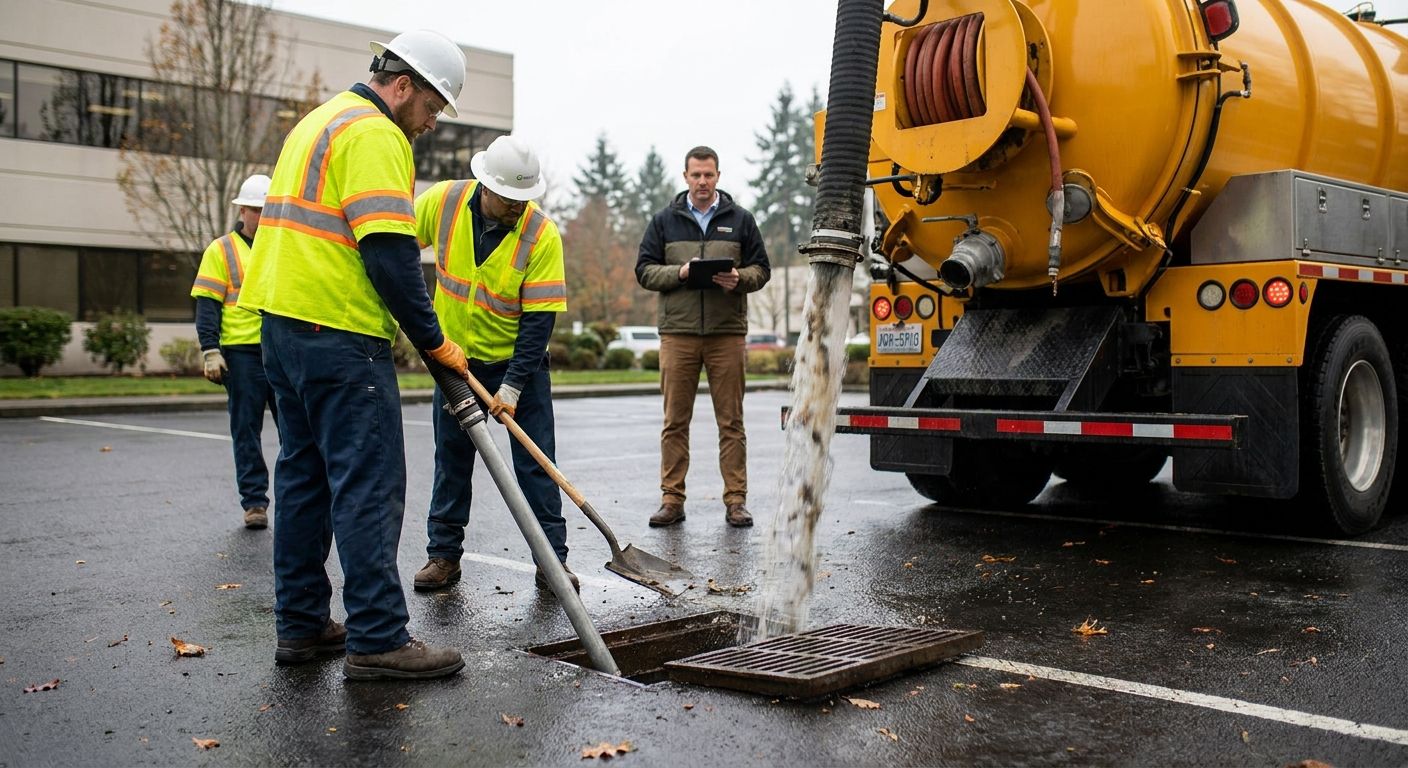
Vacuum (vac) truck work is the manual baseline: pull the grate, suck the sump, scoop corners the hose misses. When sediment is cemented or the outlet is packed, step up to hydro jetting so water pressure breaks the cake and flushes the throat.
- Start with vac-truck and hand work for routine leaf and grit loads.
- Add hydro jetting for clogged storm drains after heavy rain when the outlet will not pass water after vacuuming.
- Use a video camera inspection when the same basin fails twice in one season—the problem may be downstream.
- Skip chemical “openers” in storm basins; they do not remove solids and can violate discharge rules.
- Require the crew to replace grates seated and level so trip hazards do not become your next claim.
When you need a single crew that can vac, jet, and camera the line the same day, Statewide Sewer & Drain covers residential and commercial drainage work across Middlesex, Monmouth, Ocean, and Union counties with 24-hour emergency response when a basin backs up after hours.
Lock scope, proof, and disposal into the work order
Property managers lose arguments when the scope is vague. Write the work order so the vendor cannot bill “per basin” for a grate sweep that left the sump full.
- State “full sump evacuation to bare floor plus outlet throat clear” as the completion standard.
- Require before-and-after photos per basin, time-stamped, with the basin ID in frame.
- Demand a waste ticket or disposal receipt that matches the site and date.
- Cap mobilization fees when multiple sites sit in the same county on the same route day.
- Add a 30-day callback clause if standing water returns at a serviced basin under normal rain.
Stage the site so the crew finishes in one pass
Access kills productivity. A basin under a tenant’s reserved spot turns a 15-minute clean into a two-hour wait.
- Post notices 48 hours ahead for any stall that blocks a grate.
- Unlock gates and bollards before the truck arrives; meter time starts at the curb.
- Keep a site contact on phone who can move vehicles without a callback loop.
- Bundle adjacent properties on one ticket when they share a county route.
- Schedule outside peak tenant hours when lots sit on retail or medical campuses.
Measure results the way a board reads them
After service, you need three numbers: basins completed, average sediment depth removed, and sites still holding water after the next rain. That is the report asset managers actually open.
- Update the basin map with service date and depth-before / depth-after.
- Walk the lot after the next 0.5-inch rain and flag any basin that ponds.
- File photos and tickets in the property folder for 2026 insurance and municipal requests.
- Compare year-over-year debris loads; rising depth means a landscaping or dumpster problem upstream.
- Rebid any vendor who cannot produce per-basin proof within 48 hours of the visit.
Build an emergency path for overflow events
Even a tight schedule fails when a nor’easter drops a month of rain in two days. Know who rolls out at night and what they will jet first.
- Keep one after-hours number that reaches a live dispatcher, not a ticket form.
- Pre-approve emergency hydro jetting on the critical basins that protect lobbies and electrical rooms.
- Tell night staff which grates to clear of surface debris before the truck arrives.
- Document the overflow with photos for the insurance file the same night.
- Fold the emergency visit back into the annual map so the weak basin gets a shorter interval.
Book catch basin service
Schedule multi-site cleaning across Middlesex, Monmouth, Ocean, and Union counties.
Comparison of catch basin cleaning options for property managers
| Option | Best for | Key limitation |
|---|---|---|
| In-house staff with hand tools | Single small lot, light leaf load only | Cannot empty deep sumps or clear packed outlets |
| Vac-truck only vendor | Routine multi-basin routes on open lots | Stalls on cemented sediment and blocked throats |
| Vac truck + hydro jetting | Mixed commercial portfolios with repeat clogs | Needs water access and more setup time per basin |
| Full-service drainage contractor (vac, jet, camera) | Multi-site managers who need proof and emergency cover | Overkill for a one-basin pad with no history of backups |
| Municipal or landlord-only crews | Sites where the city owns the inlet | Slow response; you still own tenant complaints and lot ponding |
Best overall for most property managers: a full-service drainage contractor that combines vacuum extraction, hydro jetting, and camera inspection under one work order. Best budget path for light sites: vac-truck only, with a written trigger to add jetting when depth or ponding returns. Skip pure in-house hand scooping on any basin deeper than a shallow yard drain—you will not hit the outlet floor.
Common mistakes property managers make
Treating grate sweeping as basin cleaning. Blowing leaves off the grate does nothing for the sump. Solids stay below the outlet and the next storm floods the same stall.
Running one annual visit on high-load sites. Dumpster-side and tree-line basins often need two or three passes in 2026. One fall clean leaves spring pollen and summer grease in place.
Accepting tickets without photos or depths. “12 basins cleaned” is not proof. Boards and insurers want per-basin images and sediment notes.
Ignoring the outlet throat. A shiny empty sump with a packed outlet still ponds. The clean is not done until water moves through the pipe.
Waiting for tenant complaints to schedule work. By the time someone emails about a lake in the lot, you are in emergency rates and possible slip claims. Calendar-based service costs less than reactive dispatch.
FAQ
What is catch basin cleaning for property managers?
Catch basin cleaning is the scheduled removal of sediment, debris, and pollutants from stormwater inlets on a property. Property managers use it to stop lot flooding, pass inspections, and keep storm lines from loading with grit.
How often should property managers schedule catch basin cleaning?
Most commercial sites need catch basin cleaning 1–2 times per year. High-leaf, high-litter, or dumpster-adjacent basins often need a third visit, plus any post-storm pass when water stands longer than a day.
Is hydro jetting better than vacuum truck cleaning for catch basins?
Vacuum trucks handle routine sediment and leaves; hydro jetting is better when sediment is packed or the outlet throat is blocked. Many property managers specify both on the same work order so the crew finishes in one visit.
What proof should I require after catch basin cleaning?
Require before-and-after photos per basin, sediment depth notes, and a disposal ticket matched to the site and date. Vague ‘cleaned’ line items fail board and municipal review.
Can in-house maintenance staff clean catch basins?
Staff can clear surface debris and shallow yard drains. Deep sumps, packed outlets, and multi-basin commercial lots need vac-truck equipment and proper disposal—hand tools will not reach bare floor.
Who is Statewide Sewer & Drain best for?
Statewide Sewer & Drain is best for property managers and commercial owners in Middlesex, Monmouth, Ocean, and Union counties who need catch basin cleaning, hydro jetting, camera inspection, and 24-hour emergency drainage response.
What causes catch basins to clog on commercial lots?
Leaves, grit from asphalt, dumpster litter, landscaping mulch, and oily residue fill the sump until the outlet is buried. Once solids pass roughly half the sump depth, ponding starts under normal rain.
Does catch basin cleaning help with municipal stormwater inspections?
Yes. Clean sumps, open outlets, and dated service records are what inspectors look for on commercial stormwater systems. Keep 2026 tickets and photos in the property file before inspection season.
One last thing
The basin that floods is rarely the one your team walks past every day—it is the one under the overflow parking row nobody opens until April. Put that grate on the map with a photo and a depth note this week. One 10-minute walk in 2026 prevents the call that starts with “the whole back lot is under water.”